A Patch Three Pack
$20
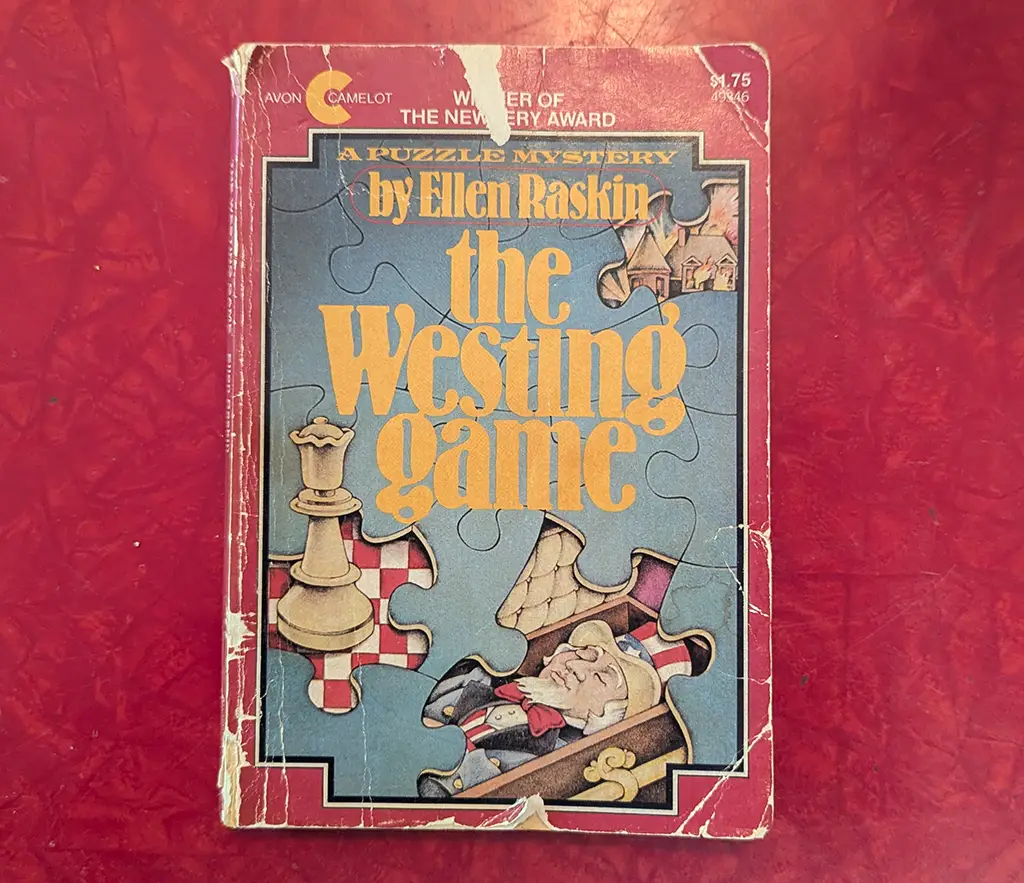
My well-worn copy of The Westing Game.
Foundational Texts is a monthly essay series that looks at some of the culture that shaped me and how it still resonates today.
Read all the installments: Jan: Jenny Holzer | Feb: The Goonies | March: The Channel 5 News Team | April: The Cave of Time | May: The Westing Game
"The sun sets in the west (just about everyone knows that), but Sunset Towers faced east."
And so begins The Westing Game, a children's mystery written in 1978 by Ellen Raskin, one of only four novels she ever wrote. It is a perfect book—or at least, for me as a kid, it was as close as it ever got.
The Westing Game tells the story of a series of neighbors, all invited to move into the aforementioned Sunset Towers, built on the shore of Lake Michigan. They are strangers to each other at first, but quickly learn that they are all heirs to the fortune of paper mill magnate Samuel Westing, and whoever solves the puzzle laid out in his will inherits his millions. Each heir is paired with a stranger and the newly formed twosome is given a set of clues, each different than the ones the other teams received.
At that point the game, as they say, is afoot.
I don't remember where I first came across The Westing Game. Probably at the library, where I would walk out with an armload of books every week. Maybe it was at school, where my teacher often put books into my hands she thought I'd like. However it was, I read it and turned around and read it right away again, I remember that for sure. At some point I acquired a copy of my own and it has accompanied me—increasingly dog-earned and torn and yellowed—ever since.
The Westing Game was the first book I read that didn't lie to me. It didn't lie the way Encyclopedia Brown lied, by keeping details hidden until the conclusion, making it impossible to solve the mystery on your own. There were no hidden clues in The Westing Game. From the very first sentence on, if you looked close enough, the answer to its central mystery was right there to discover.
But the book didn't lie about bigger things either: That parents were flawed, that adults were hiding secrets, that the world worked in ways that were both unclear and unfair. It was clear-eyed in the many ways that people fail themselves and each other, and it offered no straightforward solutions to any of it.
For me, young and unsure but having seen enough to understand that things weren't right (in the world and at home) just simply acknowledging that solved larger mysteries than the one within the book's pages.
Every character in The Westing Game is broken when we meet them. Turtle, the young girl who serves as the central figure in the sprawling cast of characters, is seething with anger at being overlooked by her narcissistic mother, who spends her time looking down on the other neighbors and doting on her eldest daughter Angela, who feels trapped in her mother's insistence that she is perfect. Other neighbors are shattered in their own ways: Flora Baumbach, a grieving dressmaker; JJ Ford, a successful judge who can't shake the struggles of her youth; Doug Hoo, a high school athlete whose father ignores his accomplishments; Sydelle Pulaski, who feels so overlooked that she fakes an injury for attention. And on and on.
It's that brokenness that I notice most when I read the book now. Everyone is flawed and sad and stuck, and it takes the other strangers letting their own guard down to help each other mend. Nobody trusts anyone when the book begins. The paired-off neighbors work together reluctantly and then, eventually, they start to help each other in ways that go beyond the puzzle they're trying to solve. By the end, they barely care about the solution, instead working together to protect one of their own from the retribution of old Sam Westing.
I've always found power and strength in found family, in communities that are built instead of born, in flawed people who find themselves by helping others and I think it probably started with The Westing Game.
Not lying to kids, teaching that that the world is complicated, that adults are flawed, and that family isn't always the people you're related to but instead the people you can trust, that's important work. It's not the only book that does that, not by a lot, but The Westing Game did it for me.
That work—of being honest with kids and helping them see that a different world is possible—is why there's been an unrelenting assault on books for kids for years now. As fascism tightens its grip, it needs people, especially the young, to not learn that they have power, that they get to build their worlds and their lives how they want, and that they can be expansive in defining who they are. It needs kids to be lied to. It needs them to feel powerless. It needs them to not find the things they need at the moment that they need them.
I found The Westing Game at a moment when I needed it, even before I knew I needed it. I needed it not because it solved my problems—it didn't—but because it trusted me enough to start asking questions.
That's the possibility awaiting every kid who walks out of the library with an armload of books, every kid that finds the one, however they find it, that might hold the solution to a puzzle that they don't yet know exists: The puzzle of themselves and their world and how the two fit together.
Published June 1, 2026. |
Here's the deal. I write about the mess we're in, how we're getting through it, and other things that make my head itch. But not lice. No cost, no spam, let's go.
Or you can always subscribe via RSS or follow me on Mastodon or Bluesky where new posts are automatically posted.
George Dale loved a fight. He loved getting in them, with the Klan, for sure, but with anyone really. And he loved watching them. This is a little work-in-progress about both.
Posted on Jun 12, 2026
Today the Arsenal, the 180-year-old British football club won the Premier League after 22 years. The lesson I took away from it was that it's never ever done.
Posted on May 24, 2026
The Zombie Revival of Dead Confederates
The Confederacy is everywhere right now, including in the new season of Rebel Spirit, out today.
Posted on May 19, 2026