A Patch Three Pack
$20
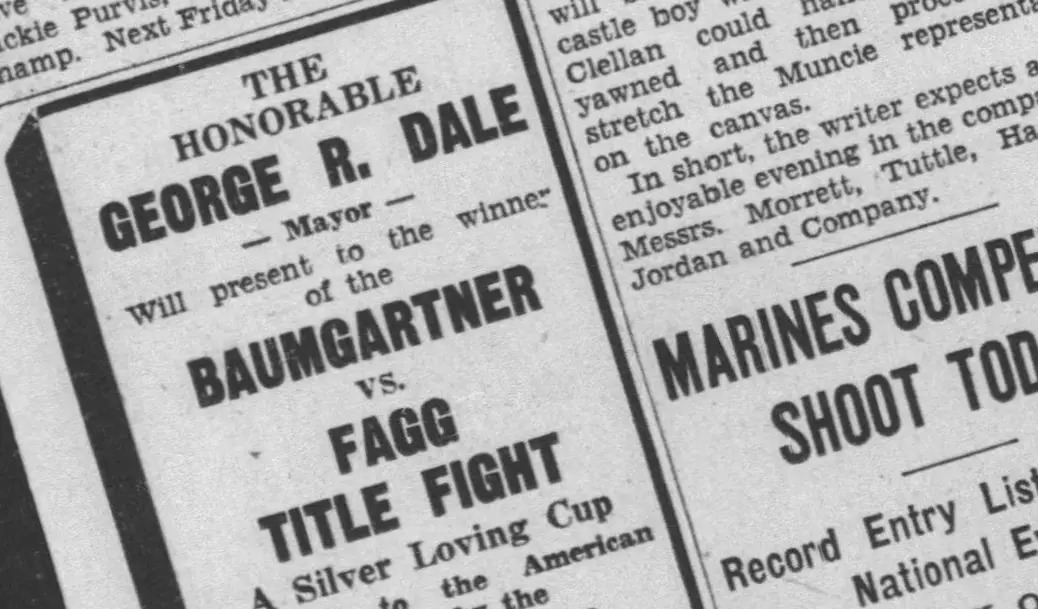
A clipping of the fight advertisement that ran in the Muncie Evening Post, September 2 1931.
As part of the process of researching and writing my book about the Klan-fighting editor George Dale, I've been penning short character studies and historical sketches most every morning. It's been a nice way to get into form—like training for a fight—and a way to work through ideas on tone and voice and practice integrating heaps of often-dry research into a readable narrative. Here's a piece from the dozens of sketches I've written, very much a work in progress, about George's love of fighting.
It was a record crowd for boxing in Muncie. It was early September 1931, and the air was still warm, the last lingering clutches of summer. The air in the armory—everyone called it the "new" Armory back then—was even warmer as the stands filled, hot and thick with the smoke from cigarettes and cigars. The crowd was loud and it was ready.
So was George Dale, now mayor of Muncie, victorious after his long battles of the 1920s.
He loved it, loved the energy of the crowd, the anticipation before the blows began. Boxing was his favorite sport, that and polo—which he'd played when he was young, back when, as he put it, it "was really dangerous." The danger was a big part of it for George. With boxing it was one-on-one, just you and them and fists.
It was a position George had found himself in for decades. Not in a ring though. In 1910, back in Hartford City before he'd moved to Muncie, before he'd started the Post-Democrat, before the Klan came to town and made his life hell, he was in court, fighting.
This is not a metaphor: this is George, in court, attacking a judge with his fists. At the time, he was the managing editor of the Hartford Journal newspaper, a reform-minded publication helmed by Charles Reeves. Reeves had been hauled into court on some bullshit and let go on what the judge said was a technicality. But before releasing him, the judge let Reeves have it, giving him the what-for.
And then.
And then, let's let the Indianapolis Star tell it:
Then his managing editor, George Dale, came in. He called the court a vile name and struck at him, and the court left his seat and started for the offender. The police interfered and Dale was taken from the room by friends. He may be arrested later for contempt of court.
George Dale loved the fight, believed in the fight, lived the fight in a way that few do. He was too slight and too unhealthy to enter the ring, so he chose a pugilist's life of a different type.
But not tonight, in the new armory, where the air was thick and the ring was lit up bright. The crowed buzzed with anticipation. This was going to be a real battle.
The main event was Moan Baumgartner, tall and lanky, known for keeping his opponents at his considerable arm's length with thirty knockouts under his belt vs Johnny Fagg, stocky and thick, who preferred to work close and deliver devastation "in a manner most pleasing to everyone but his hapless opponent," as one writer described it. The bout would be contested for the Junior Welterweight Championship of Indiana and was expected to be "one of the best scraps in many, many changes of the moon."
George would sit ringside, one of the perks of being mayor. He'd present the winner with a silver cup. Being mayor had meant that most everyone hated George—a reversion to the mean, really, after his surprise election a year ago—but nobody would deny him this moment. More than almost anyone, George's enemies knew that he loved a fight.
June 11, 1915. Hartford City's town square was beautiful. A classic Midwestern downtown square, courthouse in the center, ringed with shops and businesses. George was walking out of one of the stores on the square when he was attacked by Albert Pursley, who'd recently been the subject of an article in George's paper. It didn't start with fists, it started, as usual, with words. Pursley wanted George to expain himself, and George told him that he wasn't on the witness stand and didn't have to tell him anything. Then fists flew.
George loved a fight, but he didn't win many of them.
In Hartford City that day, it was reported that he went down quickly. George insisted that he tripped when he was trying to kick Pursley. Another witness said George fell while trying to grab a hammer from a third man to respond to Pursley's blows. Both men were arrested. The cop was Pursley's brother.
It wasn't the first time George lost a fight and it certainly wouldn't be the last. But he loved it. Loved the blows, loved the adrenaline that rushed through him. There's no other explanation that makes sense beyond he loved a fight. He picked enough of them.
Baumgartner and Fagg went eight punishing rounds that night in September 1931. Fagg got the best of the taller, longer Baumgartner at nearly every turn. It was a brutal fight on an evening that had been full of them. Four other bouts on the card, the air now thick with sweat on top of everything else. But this is what people had come for: to see these two, among the best in Indiana, wail away on each other. George was right next to the action.
Where he always was.
George Dale fought the Klan from the first time they attacked him in March, 1922, until those masked bastards finally slunk off late in the '20s. It cost him nearly everything, including his life. He never stopped, not even once, just stood up, dusted off, and squared up again. He never quit, never saved anything for later. He left it all in the ring.
The bell rang for the eighth round. Fagg squared up, his legs looked fresh, the crowd roared. They'd paid for a fight and had gotten a real one. Then Baumgartner connected with that long right, his arm swung like a rock at the end of a rope. His glove hit just behind Fagg's ear and Johnny dropped like that. First he fell to his elbows, then he crumped to the mat, unresponsive.
It was bedlam.
Fagg was rushed to Ball Memorial Hospital, still unconscious. The deputy boxing commissioner sat bedside during the long, tenuous hours. They contacted Johnny's father, who rushed in from Tere Haute and arrived in the morning. When he arrived his son was still unconscious. Johnny Fagg stayed in a coma for twenty four hours. It took days before he was finally released from the hospital.
He should have stopped fighting.
He didn't.
Five months later, Johnny Fagg was dead. A blow to the head in that same spot behind his left ear would end him in a fight in Indianapolis. This time he only lasted two rounds before he went down. The hit was so hard that his brain started bleeding and wouldn't stop. But even as he went down—not yet dead but not entirely alive—he landed a punch that almost dropped his opponent. That opponent, Albian Holden, was arrested on charges of manslaughter.
George Dale loved a fight. He was fighting before the Klan came to town and made his life a living hell and he was fighting after those rats finally scattered. He fought when the cause was righteous and he fought when there was no cause at all. And like Johnny Fagg, whose limp body he watched get carried from the ring before he climbed through the ropes and into the lights to give Baumgartner his silver cup, he never knew when to quit.
Published June 12, 2026. |
Here's the deal. I write about the mess we're in, how we're getting through it, and other things that make my head itch. But not lice. No cost, no spam, let's go.
Or you can always subscribe via RSS or follow me on Mastodon or Bluesky where new posts are automatically posted.
An Open Letter To The People Writing Lengthy Posts About 'Why I'm Going Back to Twitter'
No, really.
Posted on Oct 12, 2026
There has to be a better way of connecting and sharing and existing together, a way that isn't locked into the exploitative doom loops and psychic death of what we currently have.
Posted on Sep 23, 2026
Foundational Texts: Puzzle Pieces
The fifth installment in my monthly Foundational Texts series looks at The Westing Game, puzzles, and not lying to kids.
Posted on Jun 1, 2026