A Patch Three Pack
$20
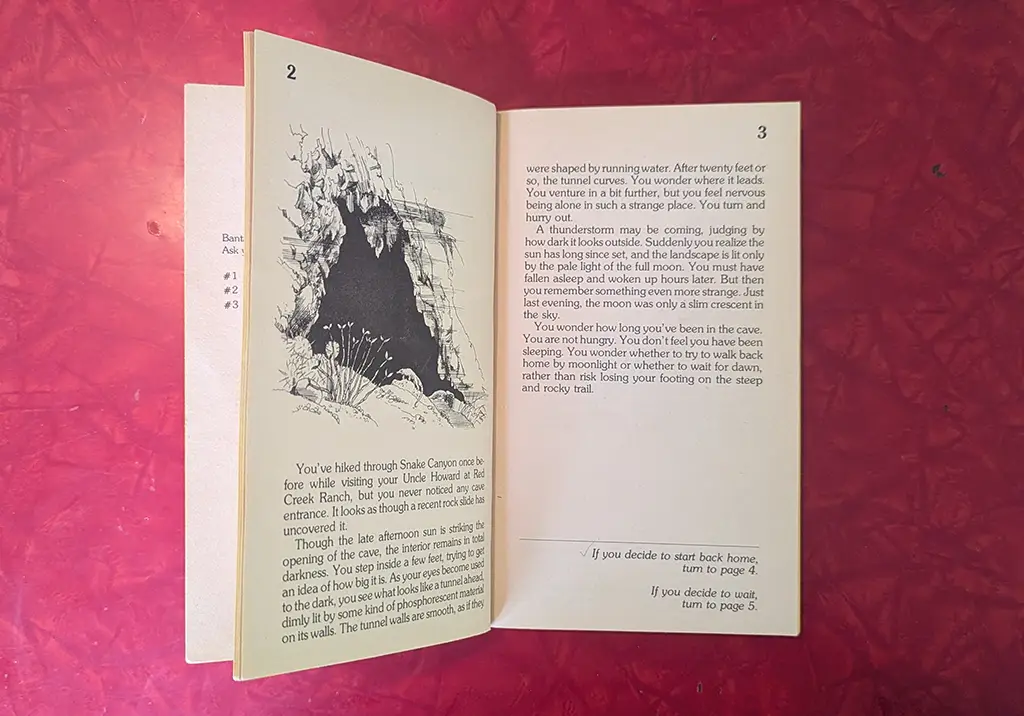
It takes just two pages before you're forced to make a choice in the Cave of Time.
Foundational Texts is a monthly essay series that looks at some of the culture that shaped me and how it still resonates today.
Read all the installments: Jan: Jenny Holzer | Feb: The Goonies | March: The Channel 5 News Team | April: The Cave of Time | May: The Westing Game
What if you could change everything?
That was question posed to me when I picked up The Cave of Time, the first installment in the groundbreaking Choose-Your-Own-Adventure series of books created by Edward Packard back in the early 1980s.
If you're unfamiliar with this particular book, you're certainly familiar with the concept: You read for a bit and then are faced with a choice. If you choose one thing, you turn to one page. If you choose another, you go somewhere else in the book. It was for me—and I think for a lot of kids, even still today—a revelation: you held what felt like infinite possibilities in your hand. Your fate was yours to choose, but every choice had unseen risks. It felt like real power.
The premise of The Cave of Time is remarkably simple: You wander into a cave and you have to find your way out. Literally, that's the entire setup. By the second page you're already making choices.
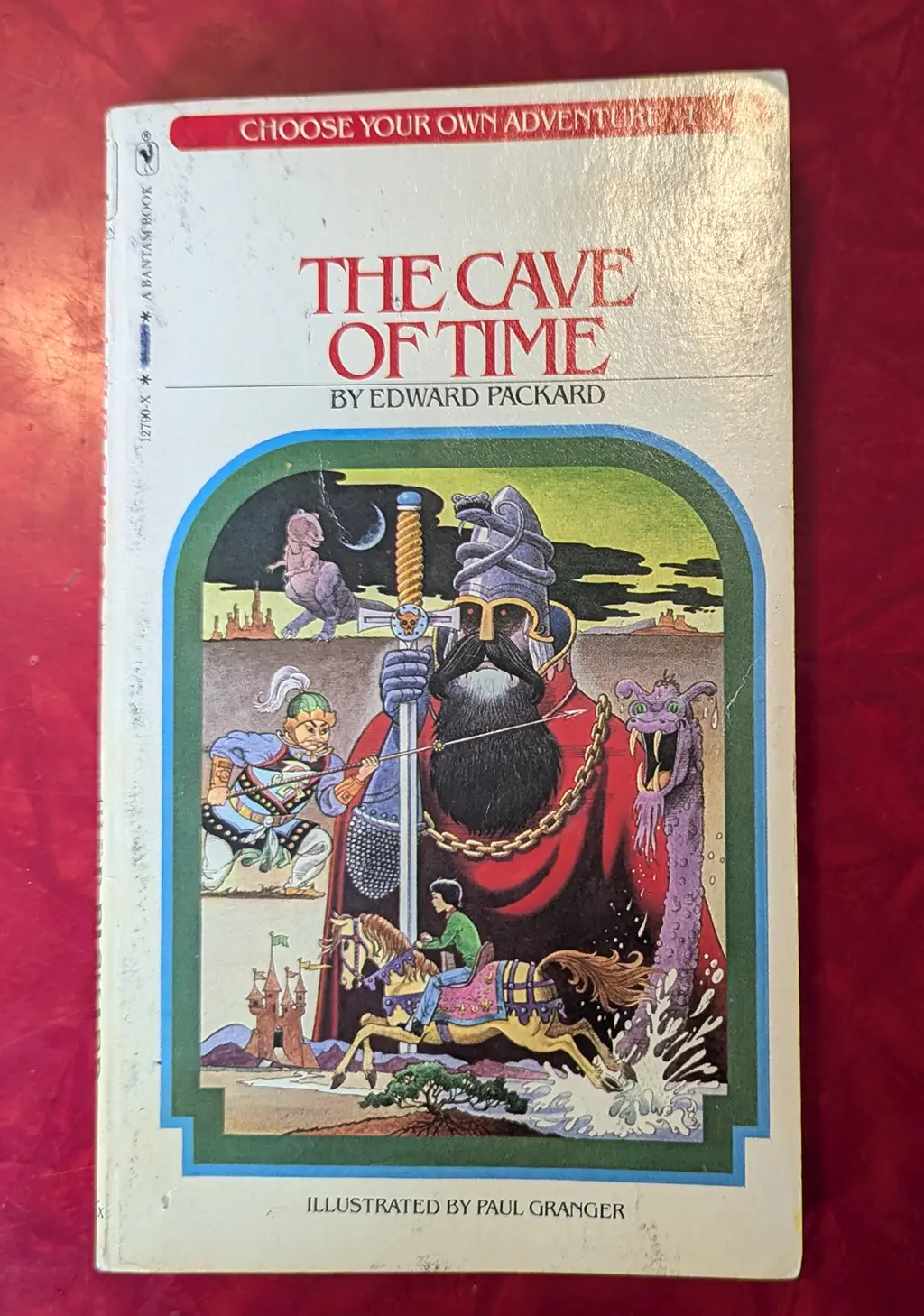
This cover absolutely rips when you are nine years old.
In The Cave of Time, nearly every page has a choice, jumping you dozens of pages between paragraphs. Almost nothing overlaps, there are no paths that bring you back to earlier choices. Sometimes it seems like every choice is a bad one, other times you go on a run of making good ones. So often you don't know which way a choice will lead. In that way it's very much like life.
As the title would imply, The Cave of Time is a time-travel book. But it doesn't just move you through time, it moves you through place. Over the course of all of its branches and forks, you could end up at Gettysburg with Lincoln, on a prehistoric plain with both cavemen and aliens, aboard the Titanic where you attempt to warn the captain to no avail, conscripted to build the Great Wall of China, or one of dozens of other fates. You get eaten at least twice—by a T Rex and the Loch Ness Monster. You die a lot. You rarely make it home.
It's that last part that sticks with me. It would be so easy to make "home" the right answer, the goal all your branching is attempting to achieve. But there are no right answers in the book, not really, only conclusions. Again, in that way it's very much like life.
As every kid will tell you—as you probably experienced yourself with whatever choose-your-own style book landed on your shelf way back when—part of the fun is paging back and following a different series of forks and branches. In the book, it's always easy to make a new choice, but those choices, ultimately, are limited by what was written.
In that way, it's not like life at all, where the ease of "paging back" isn't really a thing and where decisions are usually final but never finite. In life it is rarely easy, but always possible, to make a new choice, even one that is unwritten.
I think about new choices a lot right now, as everything falls apart around us, as rights are rolled back, as masked bastards snatch people off the street, as everything in life becomes untenably expensive, as the heat gets hotter in every respect.
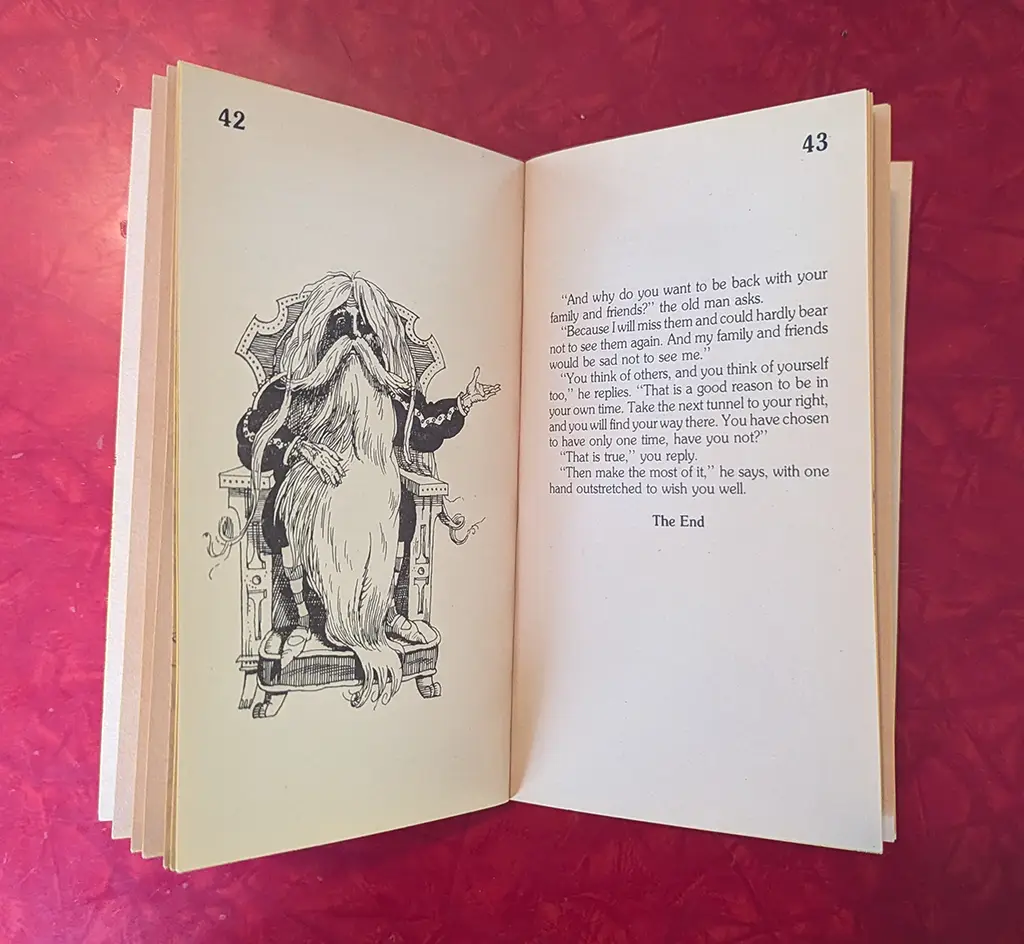
It turns out I've been chasing the look of the Philosopher my whole life
There's one branch in The Cave of Time that feels different than the others. In it, you meet an old man in the cave, an illustration depicts him sitting on a throne, his beard so big that it covers his entire body and drapes below his feet. He introduces himself as a philosopher, and explains that he's chosen timelessness so that, while nothing will ever happen in his life, he can think about life and its many choices as long as he wants. He is, it should be pointed out, not happy.
This meeting with the philosopher is unusual for a few reasons: It's the only occasion in the book where you are faced with four choices; all four of those choices are about going back home, which is not where you usually end up; and every choice leads to a final The End. This moment is so distinctly different than the rest of the book that it feels like a deliberate choice, like Edward Packard wanted to tell his young readers something.
Not every ending of the four is good. One leads you to the middle of an unnamed war where you are instantly killed by an explosion. In another, where you tell him that you want to go home because you're afraid of going to a worse time, before he grants your wish he explains that your time is no better or worse than any other. In a third, after telling you he's unhappy with his choice of timelessness, the philosopher tells you to go home "and let life be your philosophy." And then there's the last, where you choose to go home for good, and live out your life in your own time:
"You have chosen to have only one time, have you not?"
"That is true," you reply.
"Then make the most of it," he says, with one hand outstretched to wish you well.
I think about new choices a lot right now.
Life isn't The Cave of Time. New choices are hard. But they're still yours to make.
Published April 30, 2026. |
Here's the deal. I write about the mess we're in, how we're getting through it, and other things that make my head itch. But not lice. No cost, no spam, let's go.
Or you can always subscribe via RSS or follow me on Mastodon or Bluesky where new posts are automatically posted.
There has to be a better way of connecting and sharing and existing together, a way that isn't locked into the exploitative doom loops and psychic death of what we currently have.
Posted on Sep 23, 2026
George Dale loved a fight. He loved getting in them, with the Klan, for sure, but with anyone really. And he loved watching them. This is a little work-in-progress about both.
Posted on Jun 12, 2026
Foundational Texts: Puzzle Pieces
The fifth installment in my monthly Foundational Texts series looks at The Westing Game, puzzles, and not lying to kids.
Posted on Jun 1, 2026