A Patch Three Pack
$20
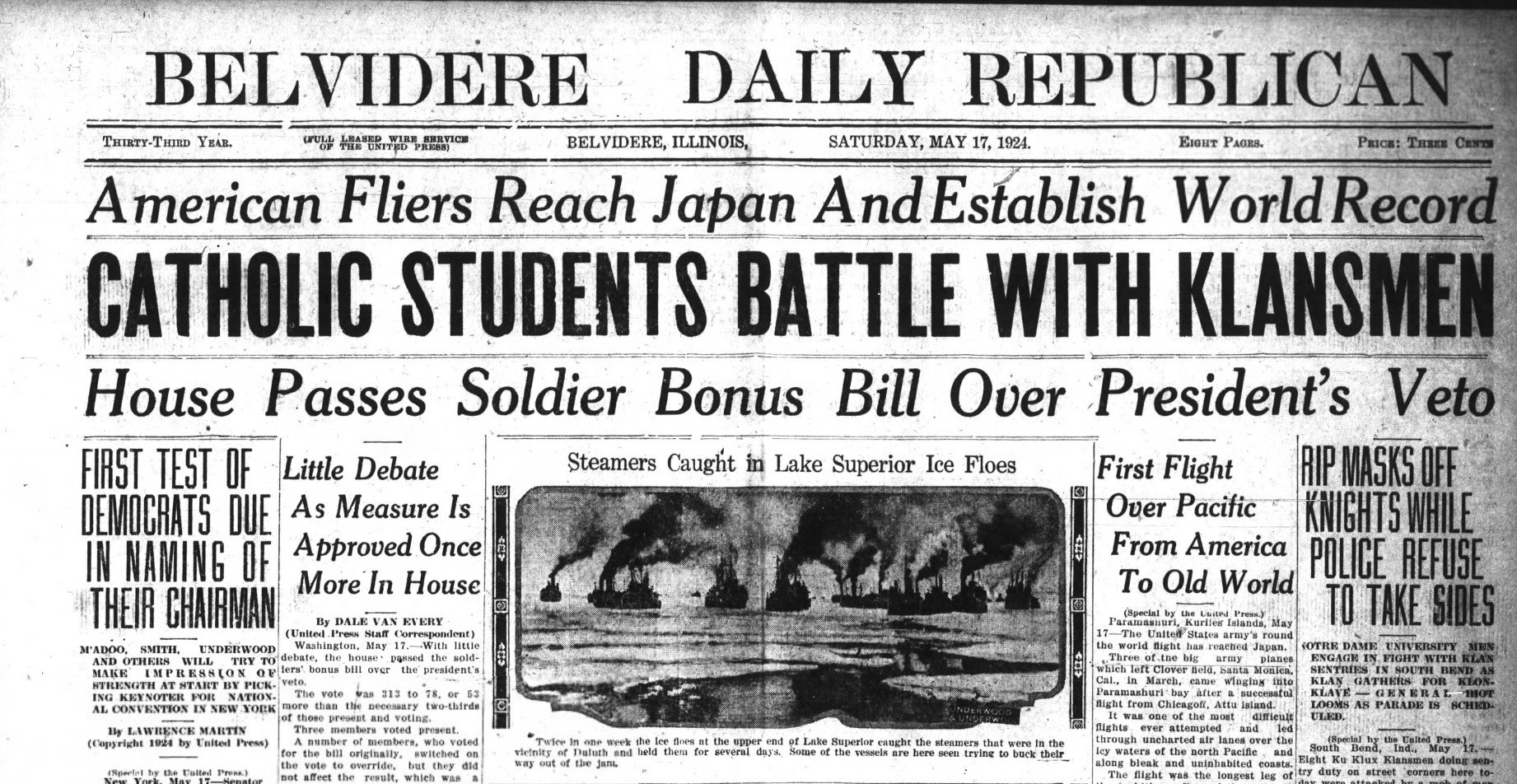
The Bevidere Daily Republican might be a small paper but they wrote a hell of a headline.
They came in waves. The Interurbans—electric trains that crisscrossed the Midwest back then—came from Michigan and Ohio and from across Indiana. Hundreds arrived on a train hired special from Chicago. And on the roads there was car after car after car, hulking and black, and overloaded with Klansmen.
It was not the first time, not by a lot. The Ku Klux Klan had been doing this for years now, showing up in huge numbers in a town, usually invited, always with a permit. Klan gatherings in the first half of the 1920s were a rally and a party and a threat all in one. Sometimes there were carnival rides, other times there were fireworks shows, almost always there were parades complete with marching bands. At night there would be barbeque and speakers spitting hate and patriotism in equal measure. And then there were crosses. Always crosses. Crosses ringed with electric lights. Pyrotechnic crosses launched into the air. And of course cross burnings, the culmination of an evening's festivities, towns all over competed to host the largest cross burnings.
But that day, May 17, 1924, it was South Bend, Indiana's turn. South Bend, the home of the University of Notre Dame, was in the crosshairs because the Klan was virulently anti-Catholic and Notre Dame was the center of Catholic education. The Klan of the 1920s wasn't just a racist organization, they expanded their hate to include Jews and Catholics and immigrants (which back then were largely one and the same, as many Jews and Catholics had recently immigrated to America from Eastern Europe, Germany, Italy, and Ireland). Expanding their hateful scope brought them huge success. The Klan of the 1920s had millions of members, a women's auxiliary, and a Junior Klan for kids. They were also politically powerful, the driving force behind the Immigration Act of 1924, which would pass 10 days later and create the US Border Patrol.
So the Klan gathering in South Bend—billed as a "May festival, celebration, and parade"—was different. Sure there would be a barbeque and a parade, but this was a show of force too. In many ways this "Konklave," as their gatherings were known, was the culmination of the Klan's anti-Catholic bigotry. They boasted that 50,000 Klansmen, women, and children would descend on the town to take part in what was expected to be a weekend-long celebration. DC Stephenson, the grand dragon of the Indiana region, and HW Evans, the imperial wizard of the national Klan, were on hand to speak. This was a big deal. This was a chance for the Klan, at the very height of their political power, to show the Catholics of Notre Dame where they stood.
Except.
Except that on this day, students from Notre Dame—back then still a men's school—were waiting.
When the first trains arrived, students beat the Klansmen so savagely that they retreated back onto their train cars. It wasn't until South Bend police arrived and cordoned off the students that the trains could unload, and the Klansmen began to descend on South Bend.
After the beatings at the train station, the Klan set up robed sentries on street corners across downtown to protect their out-of-town members as they made their way to the city park where the day's festivities would take place. Those corners became the focus of pitched battles, as throngs of students attacked the sentries, described in one account as a "flying column" that "went from corner to corner wherever a white robe appeared." Reports vary but somewhere between eight and 20 Klansmen had their robes and hoods taken that day. While some were destroyed on the spot, others were laughingly donned by the students, displaying their spoils of war.
It wasn't long before Matthew Walsh, the president of Notre Dame, issued a statement urging his students to "use your heads, not your fists."
They didn't listen.
They used their fists.
Hundreds of students chased carloads of Klansmen across town. By some accounts, at least one car was overturned. Klansmen were beaten and ran to hide. The South Bend Tribune reported that "two klansmen, after the robes had been torn from them and divided among their assailants, took refuge in a gasoline filling station."
By lunchtime, there were no Klansmen to be found on the streets of downtown South Bend.
Students surrounded the headquarters of the South Bend chapter of the Klan, which was located on Michigan Street downtown. To commemorate the weekend, the South Bend chapter had hung an electric cross outside its third-floor window, it was outlined with red light bulbs. Students stormed the building, but were met by the head of the South Bend Klan, a Baptist minister, who brandished a gun. They retreated.
The crowd grew on the street outside the Klan headquarters. Police were called in, but they were vastly outnumbered by the students. Students who were already angry. Everything was ready to explode. As it happened. across the street was a grocery store, with an outdoor display of produce.
The first potato smashed a window on the second floor, then the volleys began. Students lobbed potatoes into the windows of the Klan headquarters, sending glass careening down onto the street and then turned their attention to the "fiery" electric cross hanging outside, picking off its red bulbs one by one.
And here is where the story turns from fact to legend. Because while there's no contemporaneous reporting about it at the time, legend has it that students picked off every light bulb on the cross except for the one at the top of the cross, too high of a target to reach. That is until Harry Stuhldreher, legendary quarterback of the university's storied football team, emerged from the crowd. According to the legend, it took one throw from Harry's arm to knock out the final bulb on the cross. Sometimes a story is too good to be true but also too good to not be told.
But this is true: After taking a beating, the Klan canceled their parade. A massive Midwestern thunderstorm did away with the rest of the night's plans, washing out the speakers and the fireworks and the crosses. The promised crowd of 50,000 never emerged. By most accounts, it never got above a few thousand. When there was another confrontation between students and the Klan two days later, by that point there were only a few hundred Klanmen left in South Bend.
Let's revisit a legend one last time: Some say this battle between Notre Dame students and the Klan is why the school has the nickname "the Fighting Irish."
Legends matter. I choose to believe that one.
But true stories matter more. They give you hope when hope feels hard to come by.
A few weeks ago I spent an intense day at the Indiana Historical Society digging through their Klan archives for my book, I HATE THOSE MASKED BASTARDS!. Their Klan archives is an extensive collection that contains everything from membership cards to actual Klan robes to box after box filled with propaganda published by the Klan back in the 1920s.
In one pamphlet titled "Fifty Reasons Why I am a Klansman," they write that "the seat of our government is on the banks of the Potomac and not on the Tiber in Rome." It's a screed that sounds all too familiar right now.
When Donald Trump rails against the Pope, when Tom Homan who leads ICE's crackdown on immigrants says that Pope Leo should "leave politics alone," when Representative Elise Stefanik says "I don't want to see the Pope get involved in domestic politics," when new Catholic convert JD Vance says that the Pope "should be careful", there's no daylight between them and the Klansmen that gathered in South Bend in 1924.
Sitting in the reading room in the Indiana Historical Society, I was struck over and over again at how the language used by the Klan in the 1920s—against Catholics, against Jews, against immigrants and, of course, against Black folks—is identical to what we hear from the mouths of the administration every single day.
Before it was a Trump refrain, "America First," was a Klan slogan. They used the phrase "100% American" so much that you could order a "100% Set Piece" fireworks display from the Al-More Fireworks Company that promised to burn for five minutes. I wouldn't be surprised if someone brings it back for the America 250 celebration.
The anti-Catholic bigotry of the 1920s Klan was wrapped up in anti-immigrant rhetoric that sounds identical to today. "The vast majority of present day immigrants are either entirely non-assimilable or else extremely hard for this country to absorb," they wrote in a pamphlet titled "The Attitude of the Knights of Ku Klux Klan Toward Immigration." Back then they were railing against Catholic and Jewish immigrants coming from Europe. Today the Trump administration is saying the same thing about immigrants (many Catholic once again) coming from Mexico, Central, and South America.
The hate of today and the hate of a hundred years ago is the same hate, it's just wearing different masks. And just like then it can be defeated. But as the students at Notre Dame over a hundred years ago understood, hate doesn't go down without a fight.
Sometimes it takes a well-aimed potato.
The narrative of May 17, 1924 was built from reports written at the time from multiple sources including the South Bend Tribune, the Memphis Commercial-Appeal, the Elkhart Truth, the Chicago Defender, the Belvidere Republican, and others. Additionally two recent tellings, one from Notre Dame, who wrote their own account in 2018 and one from the Irish Echo in 2011, were helpful.
Published April 17, 2026. |
Here's the deal. I write about the mess we're in, how we're getting through it, and other things that make my head itch. But not lice. No cost, no spam, let's go.
Or you can always subscribe via RSS or follow me on Mastodon or Bluesky where new posts are automatically posted.
An Open Letter To The People Writing Lengthy Posts About 'Why I'm Going Back to Twitter'
No, really.
Posted on Oct 12, 2026
There has to be a better way of connecting and sharing and existing together, a way that isn't locked into the exploitative doom loops and psychic death of what we currently have.
Posted on Sep 23, 2026
George Dale loved a fight. He loved getting in them, with the Klan, for sure, but with anyone really. And he loved watching them. This is a little work-in-progress about both.
Posted on Jun 12, 2026