A Patch Three Pack
$20
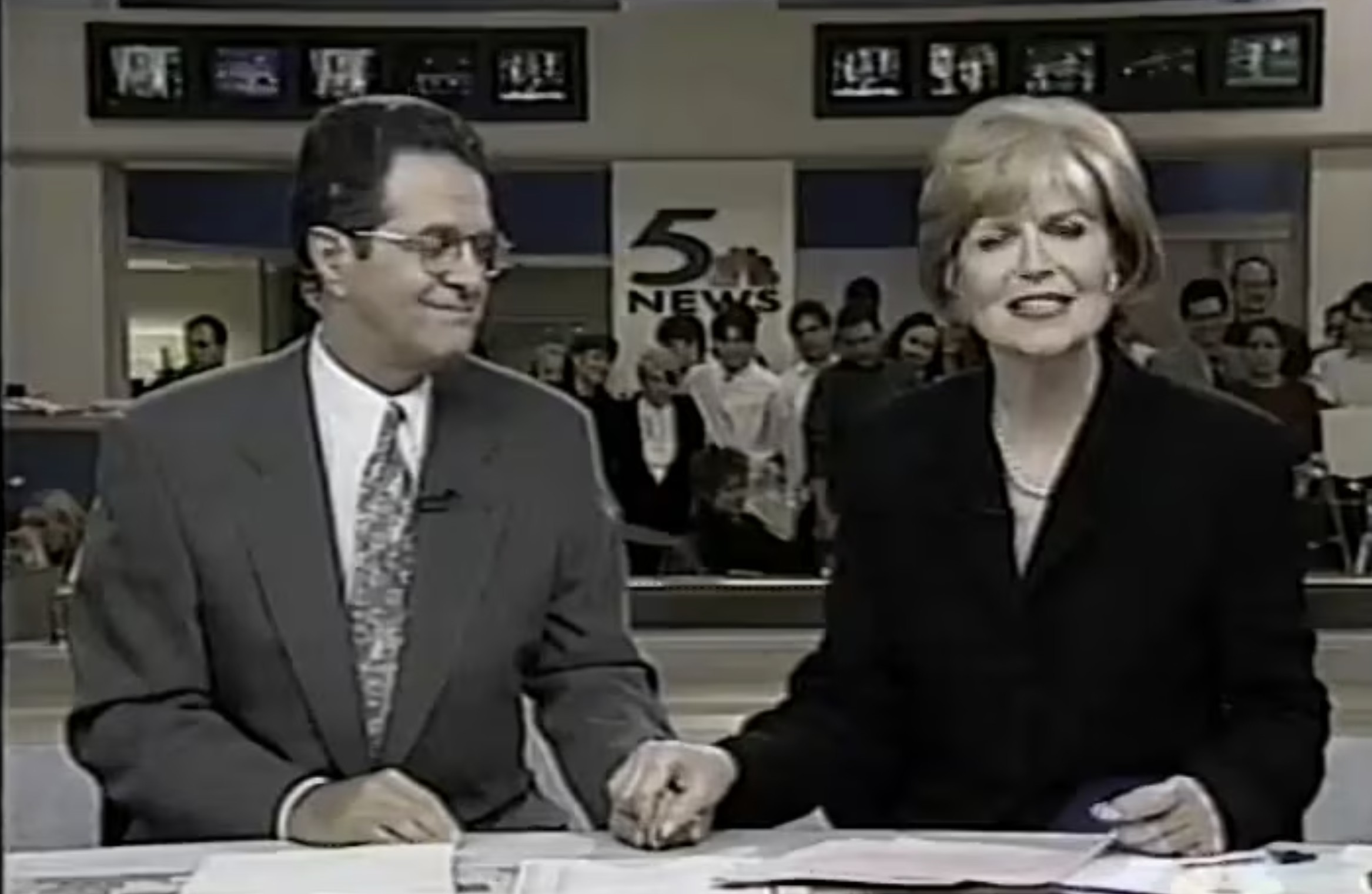
Ron Magers and Carol Marin on their last broadcast together, May 1, 1997.
Foundational Texts is a monthly essay series for 2026 looking at some of the culture that shaped me and how it still resonates today.
Read all the installments: January: Jenny Holzer | February: The Goonies | March: The Channel 5 News Team
Channel One
I was raised by the Channel 5 News Team. A latchkey kid whose parents weren't back until dinnertime, I'd come home to an empty house, make myself a snack, and park myself in front of our small TV, the kind with an antenna augmented by tinfoil. The picture was fuzzy but fine, the way everything was in late 80s.
First up was a slate of afternoon cartoons: Transformers, certainly, Inspector Gadget, reluctantly, and Voltron if you were lucky. I remember Battle of the Planets being infrequently on one of the high-number UHF channels, which was the equivalent of winning the lotto for me, but really all of that was killing time for when Channel 5 would start their news programming at 4:30.
Carol Marin, Ron Magers, Warner Saunders when one of the two big guns was out, Mark Giangreco on sports. There were others but these were the main event for me.
I don't remember exactly why I started watching the news at 11 years old or how I landed on that particular channel, but I was a kid with a lot of questions about how the world worked, and Carol and Ron would patiently sit there and explain it.
It was through Carol and Ron that I really got to understand Chicago, its politics (this was at the height of Harold Washington's run as mayor), and the many different levers that power uses here. But it wasn't just lessons about Chicago. I never went to journalism school, the best education I got about news was from watching Carol and Ron on my TV in a house empty and quiet until my parents came home and the fighting would start.
Channel Two
It's 1997, I am three years into running Punk Planet magazine and holding down a full time job in the production department of the Chicago Reader, which offered 40 hours a week crammed into three intense days, so I could focus on the magazine the other four.
Channel 5 had announced that Jerry Springer, 1990s Trash TV king, would be joining its 10pm newscast to offer his take on news events. It was a crass ratings grab and everyone knew it. Springer's show, which was filled in Chicago and featured topics like "You Slept With My Stripper Sister!" and "I Married a Horse", was closing in on besting Oprah for most-watched daytime talk show (a feat he'd accomplish, briefly, in 1998), management wanted a piece of it.
While mixing trash with news (regrettably) feels normal today, it was still fairly taboo in the late-90s, and Carol Marin and Ron Magers took a stand. Carol was first to quit, Ron followed suit shortly after. Jerry Springer lasted for less than a week on the 10pm news and Carol and Ron eventually found new gigs anchoring for the other two stations in Chicago, but they would never share a desk again.
All this shook out over a couple late night shifts at the Reader, and I remember my boss back then talking about the amount of integrity that it took for Carol and Ron to walk away from the job. One of my bellwethers ever since, as the journalism business forces ever-more compromises on the journalism job, has been what Carol and Ron taught me: You can always walk away. That measure has served me well many times.
Channel Three
Rahm Emanuel was running for mayor of Chicago and had to debate on Valentines Day, 2011. The moderator of the debate was Carol Marin, who at that point was working for Chicago's public television station, WTTW.
This was too good for me to pass up in the alternate-Chicago occupied by @MayorEmanuel, the surreal, foul-mouthed, anonymous Twitter account I wrote during the election, and so my Rahm went to the debate cocky and entirely unprepared (his debate prep partner was a duck, so he came ready to answer questions about bread crumbs and ponds).
I have no recollection how it played out in real life, but in my fictional debate, Carol proceeds to dogwalk Rahm and he drinks away his post-debate misery with a concoction he names the Carol Marin, "Delicious, and it'll kick your fucking ass." He spends the rest of his Valentines' night drunkenly throwing chunks of slush into the lake.
The @MayorEmanuel account ended a few weeks later and, after my identity was revealed, I was invited to be a guest on the Colbert Report, an experience that was amazing and surreal (and thanks to media consolidation, no longer exists on the internet).
When I landed back from that trip to do Colbert and took my phone out of airplane mode, I had a voicemail waiting: it was from Carol Marin. She was thanking me for naming a drink after her. "Now I know how Harvey Wallbanger felt," she said, laughing.
After that call, we kept talking and Carol ended up interviewing me for the @MayorEmanuel book event at the Museum of Contemporary Art in Chicago. A young performance poet/rapper named Chance opened.
Channel Four
She didn't stop calling. For years, Carol would call when she had questions about a new technology or about how journalism was evolving.
Dan, Carol Marin here, every call began.
I remember being at a party once and her calling to ask why "like" was the predominant verb on Facebook and what does it mean if a journalist "likes" something. "I don't want to have to 'like' the governor to follow what he's up to," she said, annoyed. I spent an hour in my friend's bedroom puzzling that out with her. I missed the party. It was worth it.
These calls eventually turned into a multi-year appointment with her Center for Journalism Integrity and Excellence at DePaul University where I worked with Carol and her ever-present producer Don Mosley on their investigations class, which had students working collaboratively on real investigations that would eventually air on WTTW's Chicago Tonight.
We disagreed a lot in the class, which felt awkward at first but eventually I realized that's why I was there: she wanted someone that came from an entirely different perspective than her, whose background in journalism was as far away from big-budget news desks as possible. Carol was old school, I was definitely not. So I disagreed, the students put out great work, and Carol kept inviting me back.
Channel Five
When you're a child, your world is very small and very simple. The act of growing up is, in part, the act of accepting that it is neither of those things; it is complicated and large, so large that you will never know it all no matter how long you live or how much you learn.
Right now the world feels more complicated than ever. You are likely very familiar with the feeling in the pit of your stomach that simply living in it creates. Everything feels chaotic and ever-changing, it feels impossible to stand on ground that is constantly shifting beneath your feet.
A key role of news has always been to bring some order to that chaos and a level of understanding and context to the changes happening around you. That, ultimately, is the job. Not everyone does the job well—I was lucky to grow up watching some of the best.
Watching old videos of Carol and Ron, I'm struck at how young they look. When Carol gave her final sign-off after quitting over Jerry Springer, May 1, 1997, she was younger than I am now. It would still be more than a decade before we'd cross paths, paths that would intertwine a little and remain that way for all the time since.
As a kid—11 and lonely, unsure of the world or where I fit in it—the Channel 5 News Team offered what felt like a simple guide to what was happening around me. As I've grown I've learned that there's nothing simple about it. It is difficult and it is layered and it requires real work and effort to understand.
That work is journalism, of course, but it's also the work of living.
Living is about embracing the contradictions and the complications, about making hard choices about where you stand and when to walk away, about knowing when to laugh at yourself, and about when to seek out disagreement. It's about engaging in the world to understand the world, and it's about explaining it as best you can, every day, so that others can understand it too.
Published March 31, 2026. |
Have new posts sent directly to your email by subscribing to the newsletter version of this blog. No charge, no spam, just good times.
Or you can always subscribe via RSS or follow me on Mastodon or Bluesky where new posts are automatically posted.
Porous Barriers That Divide Then From Now
I came to Muncie, Indiana this week for this moment: March 24th, the night that George Dale's life changed forever. Even 104 years later, the reverberations of history stay close.
Posted on Mar 24, 2026
Record for tomorrow the stories that today's victors would prefer we forget
The second installment in the monthly Foundational Texts series looks at the message I took from The Goonies when I was ten and is still just as relevant today.
Posted on Mar 15, 2026
Foundational Texts: Goonies Never Say Die
The second installment in the monthly Foundational Texts series looks at the message I took from The Goonies when I was ten and is still just as relevant today.
Posted on Feb 28, 2026